
Market Commentary – June 2026
17/07/2026
Key Themes Driving Currency Markets
Warsh Makes His Mark
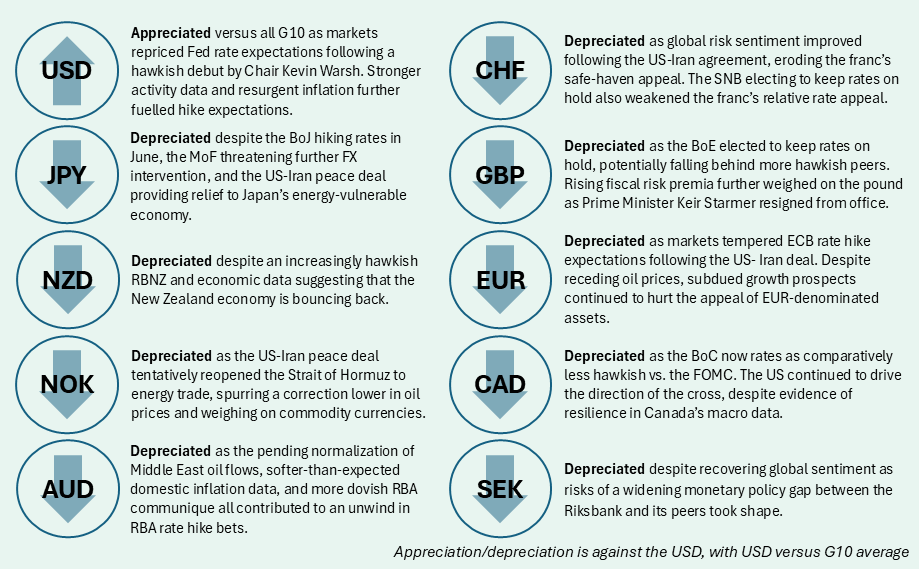
The US dollar resurgence continued into June, underpinned by improved economic data, strong equity inflows and a surprisingly hawkish debut by new Fed Chair Kevin Warsh. US payrolls data defied expectations for a third consecutive month in June as the labor market rebound continued to solidify following a dismal start to the year. The improved labor market picture combined with emerging price pressures resulted in Fed repricing with analysts leaning toward one hike by year-end.
The June FOMC meeting ultimately delivered on these hawkish expectations and then some. The FOMC left rates unchanged, as expected, but delivered a notably hawkish shift in both its communication and projections. The policy statement dropped its easing bias and, in an unusually brief format, provided no forward guidance, ending with a blunt commitment to price stability. The SEP reinforced this tone, with end-2026 core PCE revised sharply higher to 3.6% YoY (from 2.7%), while the median dot now points to 3.75%-4.00% by year-end, implying at least one hike penciled in. In the press conference, Warsh signalled a broader shift towards a more data-reactive framework, announcing reviews across key policy areas and explicitly confirming the removal of forward guidance, with potential changes to the SEP and dot plot. Overall, reduced policy signalling implies less anchoring of rate expectations, a wider distribution of outcomes, and a more event-driven volatility profile, consistent with higher rate volatility and term premia. All told, the FOMC fanned the flames of dollar strength as the US Dollar Index reached a one-year high in the aftermath.
Iran Truce Holds and Policymakers Hit Reset Button
The main force working against the dollar month-to-date was the tumultuous peace process between the US and Iran. Uneven and contradictory reporting on the situation resulted in alternating risk-on/off episodes and choppy FX trading. Mid-month, the US and Iran reached an interim agreement to reopen the Strait of Hormuz, providing tentative relief to global energy markets. Although the outlook materially improved for energy-vulnerable FX (e.g. EUR, JPY), economic damage from the three-month closure will take time to unwind as oil prices grind lower, and the ongoing war in Lebanon presents significant risks to the agreement.
The US Dollar lost a bit of momentum late in the month, as Core PCE, the Fed’s preferred measure of inflation, printed in-line with consensus, allowing for a partial unwind of the hawkish repricing episode that followed the June FOMC meeting. Central bank pricing broadly fell across the board as normalizing trade through the newly reopened Strait of Hormuz placed downward pressure on global energy markets and provided monetary policymakers greater cover to look through the current energy inflation shock.
The BoJ and ECB each delivered policy rate hikes this month, but the widely expected moves and superior US rate appeal failed to provide much support to their respective currencies vs. USD. The SNB and BoE, meanwhile, each elected to keep rates on hold in an attempt to look through the potentially transient inflation pressures stemming from the Hormuz closure. Both CHF and GBP underperformed the G4 as a result, but CHF was brought comparatively lower on unwinding geopolitical risk premium following the US-Iran agreement. GBP came under further pressure following the resignation of Prime Minister Keir Starmer from office. Andy Burnham is expected to take over as Prime Minister, and the potential for more fiscally dovish policy under his leadership has generated additional fiscal risk premia for the pound.
N.B.: This summary includes market events and currency movements up to end-of-June.
Please click here for additional information, including risk disclosures.