
Market Commentary – July 2026
14/08/2026
Key Themes Driving Currency Markets
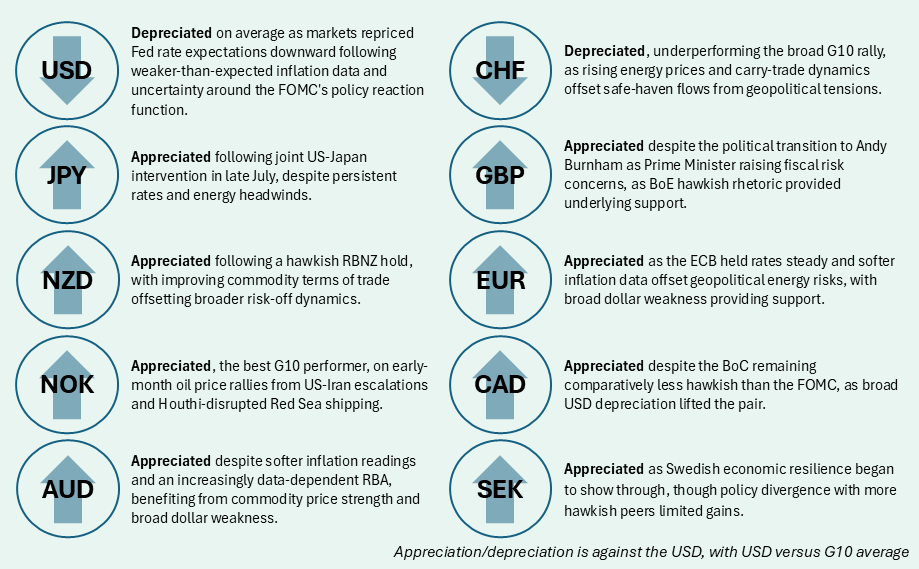
Iran War Escalation, Oil, and Commodity Support
The month opened with fresh geopolitical tensions as the Trump administration conducted targeted strikes against Iran and threatened additional military action, including proposed blockades on Iranian shipping. These escalations rekindled oil price rallies in early July, with Brent crude rising above USD 90/bbl as Houthi attacks on Red Sea shipping reinforced supply disruption fears. Energy-sensitive currencies, particularly NOK, found strong support from these developments, while energy-importers like the Eurozone and Japan faced stagflationary pressures that complicated their policy outlooks. By late month, these commodity-linked inflows to producer currencies persisted even as broader risk sentiment improved.
More intervention in the Japanese yen
Late July brought a watershed moment in Japanese currency policy. Following a hawkish hold at the July FOMC that failed to convince markets, Fed Chair Warsh’s press conference created uncertainty around the Fed’s reaction function, initially driving USDJPY lower. Building on this repricing, on Thursday morning, the US and Japan executed their first coordinated currency intervention to buy Japanese yen in nearly 30 years. The BoJ deployed at least USD 30 billion in direct yen support, while the US contributed through selling EUR/JPY rather than USD/JPY – possibly an attempt to maintain strong-dollar optics and limit the direct impact on US bond markets. The BoJ’s late-July meeting, held during this volatile period, delivered a hawkish hold at 1.00%, with one dissent for a hike and explicit commentary linking the yen’s weakness to inflation pressures. Governor Ueda signaled that the progression of the yen would influence the timing of future rate hikes. Yet despite this hawkish rhetoric, the BoJ made no policy move. The yen’s 2.1% appreciation over July rests mostly on intervention rather than a fundamental reassessment: the underlying macroeconomic backdrop of lagging Japanese yields and elevated oil prices remains.N.B.: This summary includes market events and currency movements up to end-of-June.
Fed Repricing and the Data-Dependent Pivot
Mid-month brought a significant repricing of Federal Reserve policy expectations that proved detrimental to the dollar. Chair Warsh’s congressional testimony and the July FOMC meeting delivered a cautious, data-dependent tone that surprised markets expecting a stronger tightening bias. Softer-than-expected Core PCE inflation readings gave policymakers cover to step back from the hawkish narrative that prevailed in June, and market pricing retreated from bets on two hikes by year-end. This repricing manifested as a depreciation of the dollar, with the USD falling 1.7% on average against G10 currencies in the month. The shift highlighted a broader theme across major central banks: explicit signals that policy would be data-dependent rather than pre-committed. The ECB held steady at its mid-July meeting, with President Christine Lagarde signaling future hikes remained possible but subject to incoming data. The BoE similarly maintained hawkish rhetoric while admitting greater uncertainty on growth. This transition toward a more cautious, reactive posture provided some relief to risk sentiment, particularly after weeks of geopolitical anxiety had kept investors defensive.
N.B.: This summary includes market events and currency movements up to end-of-July.
Please click here for additional information, including risk disclosures.