
Market Commentary – August 2026
09/09/2026
Key Themes Driving Currency Markets
Tokyo and Washington Step In
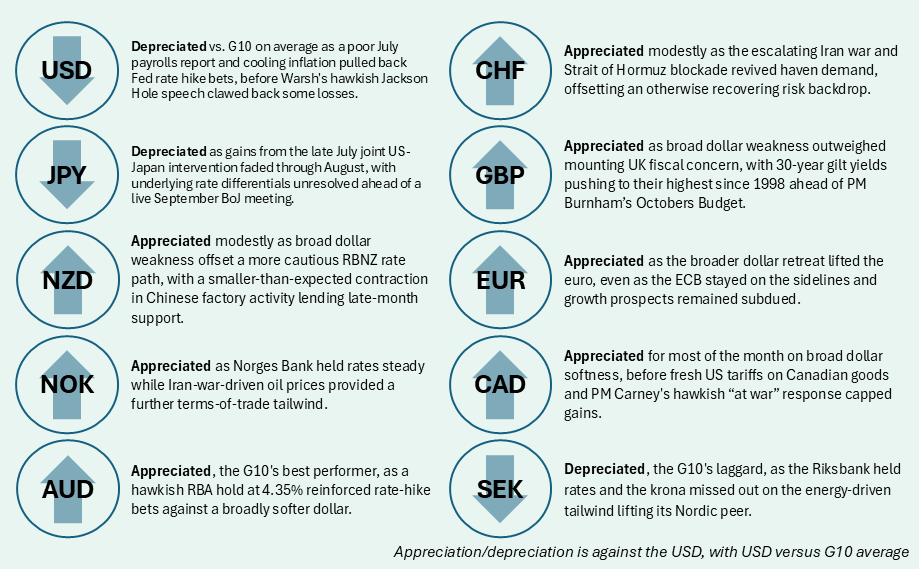
USDJPY’s slide toward 40-year lows in late July triggered the first joint US-Japan intervention in over a decade, executed July 31 when the New York Fed, acting for the US Treasury, sold euros to buy yen via EURJPY rather than selling dollars directly – a structure Treasury officials linked to preserving the administration’s strong-dollar stance. Of note, the unconventional intervention approach drew criticism from FX strategists as opaque. The yen jumped over 1% to a near three-month high, and both governments pledged further joint action “without hesitation” if disorderly moves resumed. Days later, Bessent separately asked the Fed to raise the cap on its FIMA repo facility so Japan could borrow dollars against its Treasury holdings – rather than sell them outright – to fund future interventions. In response, Japan signalled plans to draw on the facility going forward. The relief ultimately proved fleeting: JPY gave back roughly half its bounce as August wore on, leaving the currency little changed on net versus USD for the month, with rate differentials unaddressed ahead of a live September 18 BoJ meeting, at which OIS pricing implies close to a two-thirds probability of a hike.
The Iran War Grinds On
The war between the US and Iran ground into a seventh month with no resolution, and by August pressure was mounting rather than easing. US forces maintained a naval blockade of the Strait of Hormuz, redirecting 82 commercial vessels and disabling three, while Iran’s Revolutionary Guard kept restrictions “in full force” against unapproved shipping. The UK Maritime Trade Organization logged 23 projectile strikes on vessels since early July, leaving thousands of sailors stranded in the Gulf. On August 24, the Treasury unveiled “Operation Economic Outcast,” sanctioning a UAE bank over roughly $1.8bn in Iranian transactions, a day before Democratic senators and former Speaker Pelosi publicly condemned the war as a strategic failure. Oil stayed elevated near $90-100/bbl throughout, keeping a floor under global inflation expectations; UK gilt yields, in particular, pushed to their highest since 1998 by month-end, with strategists citing Iran-linked inflation risk alongside heavy AI-related corporate borrowing. The conflict remained the dominant source of intermittent safe-haven demand for JPY and CHF.
Bessent’s Treasury Twist
A climb in long-dated Treasury yields toward 2007 levels, motivated by sticky inflation and heavy corporate issuance, pushed Treasury Secretary Scott Bessent to escalate bond buybacks through August. Bessent doubled the buyback size to $4bn per operation on August 19 and signalled readiness to go further, floating the Treasury’s roughly $1trn general account as a potential funding source. Commentators dubbed the approach a “Treasury Twist,” evoking the Fed’s 2011 Operation Twist: an estimated $16bn in added quarterly purchases of 10 to 30-year debt, around 15% of annual long-bond supply, likely financed by leaning more heavily on bill issuance. The initial announcement briefly pulled the 30-year yield down 10bps to 5.18% and the 10-year down 5bps to 4.66%, but thin liquidity at the long end and market scepticism saw yields retrace within a day. Bessent has since teased a broader fiscal consolidation package touching both spending and revenue.
Warsh, Cook, and the Fed Under Pressure
Kevin Warsh used his first major address as Fed Chair, at the August 28 Jackson Hole symposium, to draw a hard line on inflation. Declaring annual core PCE of 3.3% still “too high” and progress over the past two years “modest.” Warsh said responsibility for “65 months of sustained, elevated inflation sits squarely with the central bank,” and confirmed the Fed’s retreat from forward guidance in favour of a data-driven framework built around a firm 2% PCE target. Implied odds of a September hike jumped from roughly a third to over half in the aftermath, helping the dollar recoup a portion of the month’s losses into the close. The speech landed as the White House escalated its own pressure on the Fed: on August 7, the administration sent Governor Lisa Cook a fresh removal notice over revived mortgage-fraud allegations, a second attempt after the Supreme Court blocked the first bid in June on due-process grounds. Cook, backed by her legal team, denied wrongdoing on August 26 and vowed to fight the move, keeping Fed independence under scrutiny alongside the rate debate. Bank of England Governor Bailey, also at Jackson Hole, downplayed UK second-round inflation risks ahead of the Bank’s own September 17 policy rate decision.
N.B.: This summary includes market events and currency movements up to end-of-August.
Please click here for additional information, including risk disclosures.